I grew up in a town with a liberal reputation and an overwhelmingly white k-12 school district, where racism was an animating feature of everything from zoning laws to playground “jokes.” There are obviously many places like this, and, as you know, these places typically aren’t considered to be “segregated schools” in need of political or legal remedy.
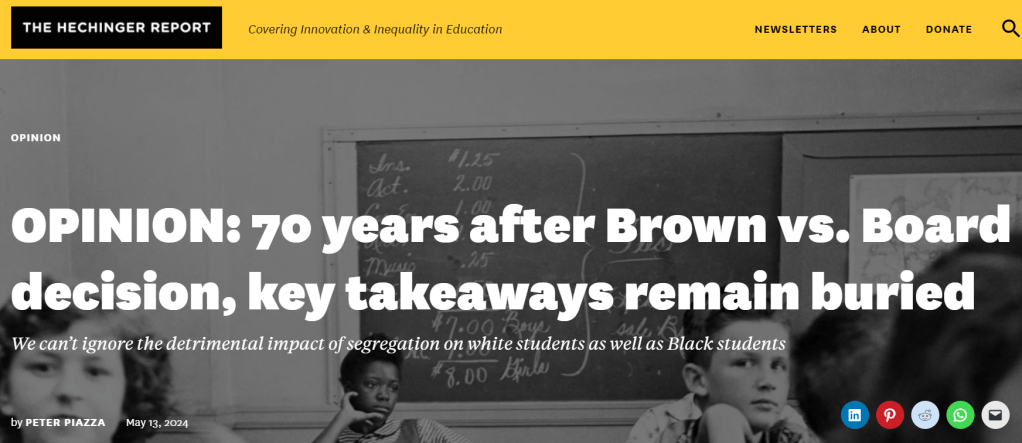
As I describe in a recent op-ed at the Hechinger Report, we ignore places with white segregation to the detriment of this extremely fragile multicultural democracy. And, we’ve been ignoring it for a long time. In a letter submitted to the Supreme Court as part of the evidence in Brown, and signed by 30 leading social scientists of the era, NAACP lawyers offered a nuanced illustration of how white student segregation is harmful both for a child’s social development and for society writ large. It’s part of the buried history from the Brown era. As I say in the piece, their predictions have largely become our reality more than seventy years later, in a chilling sort of way.
Importantly, the letter focuses on the dissonance that a white child might feel when attempting to make sense of the contradiction between stated values from progressive (or at least, center-left) family members, on the one hand, and concrete evidence of systematically racist exclusion, on the other hand. It’s the result, for white children, when they grow up in communities that don’t live their values. And, you can draw a straight line from the NAACP’s 1952 letter to more contemporary social science research, like Maggie Hagerman’s study of how “white families, even those with anti-racist intentions, reproduce and reinforce the forms of inequality they say they reject,” to name just one recent example.
Given the context of my own k-12 school experiences, this is an argument that I feel in my bones, and it echoes through the decisions that my wife and I make for our children. So, I was honored to be included in a series of essays that the Hechinger Report published for the 70th anniversary of Brown. I hope you’ll check it out! And, feel free to reach out here to let me know what you think.
I can’t end this little blurb without giving props to organizations like Integrated Schools, it’s founder Courtney Mykytyn, and new books like this one that have been influential in shaping my thinking on what it means to be a white person advocating for racial/social justice. For this particular article (and blurb about said article), I have to give the last word to Sherrilyn Ifill who wrote about this forgotten letter for the 65th anniversary of Brown. In a lecture on this same topic (which is worth a full watch), she builds the framing that I try to extend in my essay:
“Our culture discusses and commemorates school desegregation since Brown almost entirely as a project to help black people, to reinforce the self-esteem and improve the educational opportunities for Black children. But it has never been understood, as it should be, as critically important for the intellectual and social development of white children as American citizens, and as critical to our collective future as a nation.”
 School Diversity Notebook
<
div dir=”ltr”>Really liked this entry and was gre
LikeLike